Formulae for GCSE
Full GCSE Mathematics Formula List
This page provides a comprehensive collection of GCSE Maths formulas arranged by topic. It expands beyond the official exam formula sheet and includes key relationships across Number, Algebra, Geometry, Probability and Statistics.
- Purpose: For revision and reference, not for exam memorisation.
- Exam Sheet: Visit Formulae Sheet for the official exam version.
- Interactive: Click Topic Summary for explanations and examples.
Number
Percentage
Where \( P \) is the principal amount, \( r \) is the interest rate, and \( n \) is the number of times interest is compounded:
Index Laws
HCF & LCM
Highest Common Factor: Largest number that divides exactly into two or more numbers.
Lowest Common Multiple: Smallest number that is a multiple of two or more numbers.
Standard Form
Write numbers in the form:
where 1 ≤ a < 10, and n is an integer.
Error
Absolute Error: Difference between measured and true value.
Percentage Error:
Algebra
Expanding Brackets
The solution of \( ax^2 + bx + c = 0 \)
where a ≠ 0
Coordinates and straight line equations
Gradient (slope) between two points \( (x_1, y_1) \) and \( (x_2, y_2) \):
Equation of a straight line (slope-intercept form):
where \( m \) is the gradient and \( c \) is the y-intercept.
Point-slope form of a line passing through \( (x_1, y_1) \):
Parallel lines: same gradient.
Lines are perpendicular if the product of their gradients is \( -1 \) .
Midpoint between two points \( (x_1, y_1) \) and \( (x_2, y_2) \):
Distance between two points:
Equation of a circle
The standard form of a circle centered at \( (a, b) \) with radius \( r \):
Ratio
Compound Measures
Direct & Inverse Proportion
Geometry
Angles properties
Angles in polygon
Circle Theorems
Pythagoras' Theorem and Trigonometry
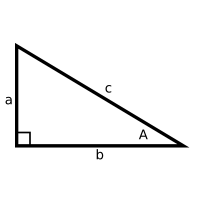
In any right-angled triangle:
\( a^2 + b^2 = c^2 \)
In any right-angled triangle ABC where a, b and c are the length of the sides and c is the hypotenuse:
Trigonometry Rules for Non-Right-Angled Triangles
In any triangle ABC where a, b and c are the length of the sides:
Sine rule
Cosine rule
Area of triangle
Special angles
| Angle (°) | \( \sin \theta \) | \( \cos \theta \) | \( \tan \theta \) |
|---|---|---|---|
| 30 | \( \frac{1}{2} \) | \( \frac{\sqrt{3}}{2} \) | \( \frac{1}{\sqrt{3}} \) |
| 45 | \( \frac{1}{\sqrt{2}} \) | \( \frac{1}{\sqrt{2}} \) | 1 |
| 60 | \( \frac{\sqrt{3}}{2} \) | \( \frac{1}{2} \) | \( \sqrt{3} \) |
Perimeter, area and volume
Where a and b are the lengths of the parallel sides and h is their perpendicular separation:
Area of a trapezium
Volume of a prism
Circle area and perimeter
Circumference of a circle
Area of a circle
Sectors of a circle
Where \( r \) is the radius and \( \theta \) is the angle in degrees:
Arc length: \( \frac{\theta}{360} \times 2\pi r \)
Area of sector: \( \frac{\theta}{360} \times \pi r^2 \)
Volumes and surface areas (cylinder, cone, sphere)
Cylinder:
Volume: \( \pi r^2 h \)
Curved surface area: \( 2\pi r h \)
Cone (where \( l \) is the slant height):
Volume: \( \frac{1}{3} \pi r^2 h \)
Curved surface area: \( \pi r l \)
Sphere:
Volume: \( \frac{4}{3} \pi r^3 \)
Surface area (entire): \( 4 \pi r^2 \)
Probability
Probability
The probability of an event A:
Probabilities range from 0 (impossible) to 1 (certain).
For mutually exclusive events A and B:
Addition Rule
For any events A and B:
Multiplication Rule
For independent events A and B:
For dependent events (conditional):
Statistics
Averages
Mean: \( \frac{\sum x}{n} \)
Grouped Mean: \( \frac{\sum fx}{\sum f} \)
Median: Middle value when data is in order
Mode: Most common value
Range
Range = Maximum - Minimum